It's been such a long time since I developed a post for the blog! So sorry. I fell victim to "frozen shoulder" this summer and it is only in the last few weeks that I've fully regained the use of my left arm. Enough of that. Just sorry if I you thought I'd disappeared.
A few months ago, Demion Clinco put together a Tucson PBS segment on Harwood Steiger. I introduced him to Joan, the Steiger niece, and he visited her, taking away personal impressions, information and examples of Steiger's brilliant talent. I'm hoping Demion will share with me the segment so that we can post it here. We'll see.
There is growing interest in collecting Steiger fabrics. Now, if you go to Ebay, you'll find that the prices have more than doubled over a few years ago. Some sellers, I fear, don't really understand the items and place way over the top prices on them. One of the things that got me collecting in the first place was the affordability of these practical pieces of art. Now, I have to be very selective in purchasing, and only buy new designs of which I don't own any example. Even then, I get kind of particular. My husband says that I have single handedly driven up the prices. I laugh at that, of course. There are hundreds of folks who collect these Arizona icons and thousands more with interest. My blogs stats tell me that we've had 3,500 visitors. A small number by commercial standards, but impressive for a single topic blog. Keep coming back. I promise more great new photos.
Harwood Steiger Book Project
The Harwood Steiger Book Project blog is a stream of consciousness about the development of a book on Steiger's silk screened textiles. This blog represents the process of documenting the hundreds of silk screen designs produced by Steiger and his wife, Sophie, over a 40 year period in Tubac, Arizona, where they had a studio and helped to make the community of Tubac a place where Art Meets History. This is only a small part of what I have learned about the man and his work.
Friday, October 26, 2012
Tuesday, June 26, 2012
Tuesday, June 12, 2012
TROLLING FOR TREASURES
During the last few months, I have collected a number of images that fall into the miscellaneous Harwood Steiger category. Some of these images come from my daily diligent searches on Ebay. Others, I just happened across. These items are not something I would necessarily be interested in owning, but they are worthy of documentation. Unfortunately, the information is limited and ownership unknown. So, I'll just let the images speak for themselves.
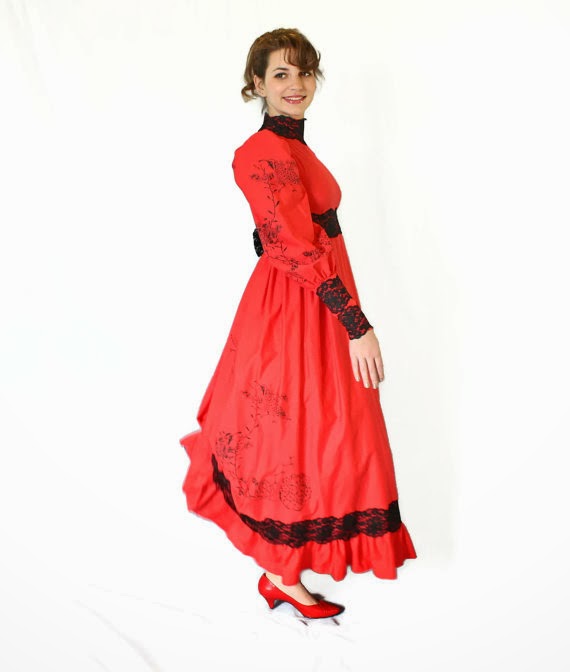
First, here's a great square dance ensemble that made my eyes pop out. Can you imagine how much fabric went into making this? Ironically, it is made in the fabric called, Square Dance. It's a beauty. It was offered on Ebay, but didn't sell. So, the owner either still has it, or sold it off-line.
This is called, Spices. no doubt, Sophie Steiger, a wonderful cook and gifted herbalist, had something to do with the creation of this design. It is the only example of Spices I've ever seen and it sold on Ebay. It was a rather small piece of fabric as I recall.
First, here's a great square dance ensemble that made my eyes pop out. Can you imagine how much fabric went into making this? Ironically, it is made in the fabric called, Square Dance. It's a beauty. It was offered on Ebay, but didn't sell. So, the owner either still has it, or sold it off-line.
This is called, Spices. no doubt, Sophie Steiger, a wonderful cook and gifted herbalist, had something to do with the creation of this design. It is the only example of Spices I've ever seen and it sold on Ebay. It was a rather small piece of fabric as I recall.
This amazing beauty is a table cloth, the likes of which I've never seen and don't know anything about. It is so breathtakingly beautiful! I love the color, composition and subject matter. It is very unlike any Steiger table cloth I've found and were it not for the signature in the corner, I'd be hard pressed to identify it as a Harwood Steiger work. It, also was offered on Ebay and sold for a fortune.
I love this example of Out West. The color is fabulous. It was also offered on Ebay and sold for more than I could ever afford. If I recall correctly, it was a four yard piece.
I just thought you might enjoy seeing these wonderful examples. It is my custom to use my own items on the blog. But, every once in a while, something absolutely wonderful comes to light and merits inclusion.
Monday, June 11, 2012
TAKING ON NEW TASKS
| Seven Cities of Cibola |
Luckily, again, someone reading this blog has contacted me and offered Harwood Steiger treasures found in her mother's stash. They were designs which were totally new to me. Both are abstracts and not obviously traditional Steigers. But, Caravan and Scheherazade are clearly in Steiger's distinctive abstract style. Scheherazade is lively, fanciful and fun. Executed in hot pink and medium brown ink on ivory colored fabric, it has lots of spirals, lattice designs, and tent shapes. It calls to mind tents billowing on desert sands. I think Sophie Steiger exactly captured the mood of this fabric in naming it. The piece is generously sized, so I think I'll just set it aside for a while and wait for inspiration.
Caravan is a very complex design. It flows from tightly detailed areas to open areas, punctuated with floating elements. It is very, very interesting and contains many varied design elements such as balloons, shields, faces, webs, plants and a whole lot more. Caravan is printed in hot pink and black inks on a medium pink background. It is truly unique among Steiger designs and hard to categorize, other than to say it is an abstraction and highly stylized. Again, this a generously sized piece of fabric, so I have lots of options when considering how best to use it. People who know me will attest that pink is not a color I often select. But, there is nothing girly-girly about these Harwood Steiger fabrics. And, I must add that I am thrilled to have them in my collection.
These two new Harwood Steiger designed fabrics underscore an important fact: There is no way of ever knowing how many Harwood Steiger designs exist. If only someone had kept records over the years! If you have any Steiger fabric treasures, please, please send me pictures. You just may be hoarding one I've never seen! Contact me here and we'll take it from there.
Thursday, March 8, 2012
BEING FOUND
It's interesting that new items surface from the great sea of collectors out there. I've been contacted twice this week by people who wandered to this blog because they happened to find Steiger treasures. One lady had over two yards of Mesquite and Palo Verde along with some other choice designs. I was fortunate that she was willing to sell to me items not in my collection. Another person has a great little tote bag and some scraps for sale. She needed help in identifying them for sale on Ebay. Another great item on Ebay is a two piece dress (skirt and bolero top) made out of Saguaro. It's really lovely, and would be a fabulous buy if not for the stain on the skirt. But, if you wanted to take it apart and use the fabric in a different way, it would be a really good buy.
Steiger fabrics have really become a lot more expensive since I started collecting a few years ago. My husband says that it's all my fault because I've bought so many and have, therefore, driven up the price. I think it's because many more people are becoming aware of the great designs Steiger produced. And, of course, baby boomers, like myself, are nostalgic about the designs of the 1950's and '60's. I know that I have a great fondness for mid century modern design in all things. Perhaps that's why Harwood Steiger's Sonoran Desert designs speak to me so compellingly. He marries that great mid century panache with desert subjects near and dear to my heart.
Lesser known and harder to recognize are Harwood Steiger's abstract designs. They are plentiful and diverse. Very mid century modern, indeed. Very atomic. Very loose and fun. Don't overlook these when collecting. Steiger created a series of abstract designs named after Santa Cruz valley towns. Many design elements from Native American and Mexican cultures are incorporated into the abstracts. Most are printed in at least two colors of ink and often more. That means for every color, the fabric was hand inked, dried and then inked again. Amazing when you consider that the stencils were usually around 18 inches wide and required exacting registration. The Steiger's were true artists and precision crafts people.
What is truly amazing is that the Steiger's never went commercial by selling through other retailers. All of the examples that continue to surface from around the world, all were acquired in Tubac at the Harwood Steiger studio.
Steiger fabrics have really become a lot more expensive since I started collecting a few years ago. My husband says that it's all my fault because I've bought so many and have, therefore, driven up the price. I think it's because many more people are becoming aware of the great designs Steiger produced. And, of course, baby boomers, like myself, are nostalgic about the designs of the 1950's and '60's. I know that I have a great fondness for mid century modern design in all things. Perhaps that's why Harwood Steiger's Sonoran Desert designs speak to me so compellingly. He marries that great mid century panache with desert subjects near and dear to my heart.
Lesser known and harder to recognize are Harwood Steiger's abstract designs. They are plentiful and diverse. Very mid century modern, indeed. Very atomic. Very loose and fun. Don't overlook these when collecting. Steiger created a series of abstract designs named after Santa Cruz valley towns. Many design elements from Native American and Mexican cultures are incorporated into the abstracts. Most are printed in at least two colors of ink and often more. That means for every color, the fabric was hand inked, dried and then inked again. Amazing when you consider that the stencils were usually around 18 inches wide and required exacting registration. The Steiger's were true artists and precision crafts people.
What is truly amazing is that the Steiger's never went commercial by selling through other retailers. All of the examples that continue to surface from around the world, all were acquired in Tubac at the Harwood Steiger studio.
Tuesday, February 28, 2012
WELCOMING SPRING
While new snow is falling on much of the country, Spring has already arrived in the Sonoran Desert. Last week we were experiencing temperatures exceeding 80°. I will confess that we are now in the 60's, but only for a few days. The ground has warmed up enough to encourage new growth of both wanted and unwanted plants. I spent three hours on Sunday ridding the front yard of the most common city weeds. While I worked I was reminded that Harwood Steiger found beauty in all things that grow here. In fact, some of his most beautiful creations are representations of the wild weeds that grow everywhere. Steiger loved the weeds so much that he created several different fabrics with weed designs. They are all called Weeds, but are distinctly different. The one I used to make a dress shows different weeds in brick like block outlines. Another shows just single leaves of various weeds. And, the third shows the full plant, but spread out in the field of design. I find them all lovely. In addition, Steiger created many stunning designs depicting inconspicuous wildflowers and roadside blooms. Perhaps due to Sophie Steiger's influence, we are gifted with accurate representations of what grows profusely in the Sonoran Desert.
It is not easy to identify all of the flowers shown in the various designs. So many of them are stylized, but still accurately rendered . Because most appear in only one color, I personally, cannot identify many of them. But others are obvious. Beyond the cactus flowers one can easily find penstemon, roses, foxglove, and many other Sonoran specific blooms. Even the noxious Tumbleweed has found its place in Steiger's design portfolio. In fact, one of my favorite garments is the two-piece dress I made from Tumbleweeds.
Other signs of Spring's arrival are the many birds which enliven the days. Several pairs of hummingbirds are vying for dominance at the feeder I placed among the contorted branches of the Mesquite tree. At least one hummer appears every 7 minutes. But often, two show up at the same time and an aerial battle begins. No harm comes to either bird, but clearly the victor eats first while the other bird perches in the Mesquite. One of my favorite Steiger fabrics is the exquisitely rendered Mesquite which almost looks Japanese in its esthetic. I have only seen it once, and it was in black and white. The lady who owns it, told me that her mother made fabric shutters for the family room out of it. It must've been a stunning room.
I am grateful that Harwood Steiger had such a distinguished perspective and the remarkable ability to provide us with an eye to the beauty of the things that grow in the Sonoran Desert. Thank you, Harwood and Sophie, for helping me find and appreciate the beauty of the mundane growing all around me.
It is not easy to identify all of the flowers shown in the various designs. So many of them are stylized, but still accurately rendered . Because most appear in only one color, I personally, cannot identify many of them. But others are obvious. Beyond the cactus flowers one can easily find penstemon, roses, foxglove, and many other Sonoran specific blooms. Even the noxious Tumbleweed has found its place in Steiger's design portfolio. In fact, one of my favorite garments is the two-piece dress I made from Tumbleweeds.
Other signs of Spring's arrival are the many birds which enliven the days. Several pairs of hummingbirds are vying for dominance at the feeder I placed among the contorted branches of the Mesquite tree. At least one hummer appears every 7 minutes. But often, two show up at the same time and an aerial battle begins. No harm comes to either bird, but clearly the victor eats first while the other bird perches in the Mesquite. One of my favorite Steiger fabrics is the exquisitely rendered Mesquite which almost looks Japanese in its esthetic. I have only seen it once, and it was in black and white. The lady who owns it, told me that her mother made fabric shutters for the family room out of it. It must've been a stunning room.
I am grateful that Harwood Steiger had such a distinguished perspective and the remarkable ability to provide us with an eye to the beauty of the things that grow in the Sonoran Desert. Thank you, Harwood and Sophie, for helping me find and appreciate the beauty of the mundane growing all around me.
Monday, January 9, 2012
BIRDING A LA HARWOOD STEIGER
A roadrunner has recently moved into our neighborhood. Most often seen in undisturbed, natural habitats, I was a little surprised to see him racing around suburbia. I first saw him running atop our block wall fence in the back yard. Now, I see him most often across the street or darting between houses. Today, he took advantage of the pleasant sunshine and hunted in our front yard. That gave me a wonderful opportunity to observe him up close from the window. I was awed by the remarkable markings on this bird---so vivid and distinctive. No wonder Harwood Steiger used them so liberally in his designs!
There is no doubt that roadrunners capture our attention and imaginations. They are large, move distinctively and have such unique plumage. And, after all, we grew up watching the roadrunner outwit the coyote. Roadrunners must have made a powerful impression on Harwood Steiger. These birds appear in dozens and dozens of his fabulous designs, either singly, or grouped in a scene, or showcased among the cacti.
The first Steiger example I purchased was a table cloth and it was the comical roadrunners that captured my affections. Since then, I have collected quite a few of the birds in a variety of depictions. Steiger presented the birds in realistic renderings and abstractly, too. The birds appear portraited, shown hunting and running, nesting and resting. And, in each representation, one can clearly see that this is no other bird, except a roadrunner. The long tails and head crowns are unmistakably roadrunner. If they were not so humorous, one might call them regal. Be sure to scroll down at see them in At Play, Square Dance, etc.
The Aztec style roadrunner appears in several different examples. The one shown here has two facing birds and the pairs are set wide apart in the fabric run. Sparingly used in this instance, the birds appear with great effect on a heavy, nubby cotton that is much like linen. Printed in one color only, Steiger produced them in black, deep red, blue, forest green and brown. The same bird is incorporated into what I call my Aztec tablecloth. Not precisely the same, the birds are woven into a visual jig saw puzzle of Aztec motifs. So ingeniously done, I did not recognize them at first. Scroll down to see the Aztec dress panel, the Aztec border print and the table cloth.
By far, my favorite roadrunners are the simply rendered ones that are so busy being desert dwellers that they make me smile. I love the way these two in Paisano seem to be figuring out how to split that little lizard, or more likely, who's going to have it for an appetizer. I wonder how much time Harwood Steiger spent bird watching. He captured their behavior so perfectly. For example, in Running Birds, the border print, the roadrunner's legs are completely outstretched, capturing the idea of just how fast these birds run. They are fast, very fast.
I also greatly admire the way Steiger presents the birds in an almost stately manner, as in the cholla dress panel. They are highly detailed and shown in their full splendor. Depicted in their natural element, these birds are right at home, and to me, look like a courting pair.
Harwood Steiger had a real gift for capturing the nature of these wonderful Sonoran desert birds. I am grateful that he took such a fancy to our avian friends and shows them in wonderful variety.
There is no doubt that roadrunners capture our attention and imaginations. They are large, move distinctively and have such unique plumage. And, after all, we grew up watching the roadrunner outwit the coyote. Roadrunners must have made a powerful impression on Harwood Steiger. These birds appear in dozens and dozens of his fabulous designs, either singly, or grouped in a scene, or showcased among the cacti.
The first Steiger example I purchased was a table cloth and it was the comical roadrunners that captured my affections. Since then, I have collected quite a few of the birds in a variety of depictions. Steiger presented the birds in realistic renderings and abstractly, too. The birds appear portraited, shown hunting and running, nesting and resting. And, in each representation, one can clearly see that this is no other bird, except a roadrunner. The long tails and head crowns are unmistakably roadrunner. If they were not so humorous, one might call them regal. Be sure to scroll down at see them in At Play, Square Dance, etc.
The Aztec style roadrunner appears in several different examples. The one shown here has two facing birds and the pairs are set wide apart in the fabric run. Sparingly used in this instance, the birds appear with great effect on a heavy, nubby cotton that is much like linen. Printed in one color only, Steiger produced them in black, deep red, blue, forest green and brown. The same bird is incorporated into what I call my Aztec tablecloth. Not precisely the same, the birds are woven into a visual jig saw puzzle of Aztec motifs. So ingeniously done, I did not recognize them at first. Scroll down to see the Aztec dress panel, the Aztec border print and the table cloth.
By far, my favorite roadrunners are the simply rendered ones that are so busy being desert dwellers that they make me smile. I love the way these two in Paisano seem to be figuring out how to split that little lizard, or more likely, who's going to have it for an appetizer. I wonder how much time Harwood Steiger spent bird watching. He captured their behavior so perfectly. For example, in Running Birds, the border print, the roadrunner's legs are completely outstretched, capturing the idea of just how fast these birds run. They are fast, very fast.
I also greatly admire the way Steiger presents the birds in an almost stately manner, as in the cholla dress panel. They are highly detailed and shown in their full splendor. Depicted in their natural element, these birds are right at home, and to me, look like a courting pair.
Harwood Steiger had a real gift for capturing the nature of these wonderful Sonoran desert birds. I am grateful that he took such a fancy to our avian friends and shows them in wonderful variety.
Friday, September 16, 2011
CREATING SMILES ABOUT DESERT LIFE
One of the things I love most about Harwood Steiger's desert designs is the humor he assigns to the critters who live here. Most often when folks think of desert critters, they imagine the scary ones. You know the ones I mean: Gila monsters, rattlesnakes and scorpions. They are venomous, sometimes lethal. and enjoy the greatest notariety among non-desert dwellers. To be sure, they are here, but not in the invasive, dangerous manner that most people fear. The desert predators pretty much stay as far away as we'd like them to stay. Interestingly, Steiger never included anything that should be feared in his designs. More often, desert people encounter interesting and benign creatures like lizards, birds and insects. These are the critters that are far more common and obviously they amused Harwood. That's why so many of them are portrayed in his designs in such humorous ways.
There is no doubt that Harwood loved those crazy roadrunners. He used them over and over as the central element in many textile designs. One need only look at the highly collected and classic Steiger designs like Square Dance, Running Birds, More Quail, At Play, Desert Clowns and of course, the untitled dress panels and table cloths. Roadrunners appear dancing, running, hunting, playing and just plain posing. Look at the dignity assigned to his Aztec Roadrunners. The beauty of these birds is often portrayed in detail in designs like Paisano and the magnificent Cholla and Roadrunner dress panel. But, one of my favorites shows them hunting lizards in Running Birds. A juvenile bird is eagerly chasing a small lizard. So cute. Not to be outdone, Steiger's quails join in the fun, as well. These distinctive birds are often seen in families busy doing what quails do. Although, usually a plant eater, quail can be seen chasing a lizard or bug, too.
Have you seen Owls? Usually portrayed as very dignified birds, Steiger's owls are almost cartoonish as they perch on tree branches.
I love the ants marching along in Bow Knots. They are interspersed with the beautifully tied bows and flowers. Keeping the ants company are a variety of butterflies. We have many varieties of butterflies in Arizona and they are plentiful no matter where you go. Speaking of butterflies, a gargantuan sized group are presented in Mariposa in a striking example of Steiger's gift. Not to be overlooked, Idyll portrays butterflies flitting across the tops of flowers and a ribboned border. They look to be performing an aerial ballet. This border print is absolutely stunning.
It's hard to compare Harwood Steiger's textiles to those produced today. Now, silk screens are laser cut from a two dimensional design. Harwood Steiger's approach is radically different. He free-hand cut the designs straight from his head, seldom producing a sketch in advance. The stencils were cut from a plastic film by hand. So, he could interject a fun comment as the mood struck him. Can you see Harwood Steiger sitting at his table cutting away to create complex, beautiful compositions and then adding just a little bit of whimsy, like a baby roadrunner chasing a tiny lizard in the border of a tablecloth? I can. I also know that he must have smiled at the little joke. What a wonderful man Harwood Steiger was. He created beautiful things and forty years later, he's still making us smile. How good is that?
There is no doubt that Harwood loved those crazy roadrunners. He used them over and over as the central element in many textile designs. One need only look at the highly collected and classic Steiger designs like Square Dance, Running Birds, More Quail, At Play, Desert Clowns and of course, the untitled dress panels and table cloths. Roadrunners appear dancing, running, hunting, playing and just plain posing. Look at the dignity assigned to his Aztec Roadrunners. The beauty of these birds is often portrayed in detail in designs like Paisano and the magnificent Cholla and Roadrunner dress panel. But, one of my favorites shows them hunting lizards in Running Birds. A juvenile bird is eagerly chasing a small lizard. So cute. Not to be outdone, Steiger's quails join in the fun, as well. These distinctive birds are often seen in families busy doing what quails do. Although, usually a plant eater, quail can be seen chasing a lizard or bug, too.
Have you seen Owls? Usually portrayed as very dignified birds, Steiger's owls are almost cartoonish as they perch on tree branches.
I love the ants marching along in Bow Knots. They are interspersed with the beautifully tied bows and flowers. Keeping the ants company are a variety of butterflies. We have many varieties of butterflies in Arizona and they are plentiful no matter where you go. Speaking of butterflies, a gargantuan sized group are presented in Mariposa in a striking example of Steiger's gift. Not to be overlooked, Idyll portrays butterflies flitting across the tops of flowers and a ribboned border. They look to be performing an aerial ballet. This border print is absolutely stunning.
It's hard to compare Harwood Steiger's textiles to those produced today. Now, silk screens are laser cut from a two dimensional design. Harwood Steiger's approach is radically different. He free-hand cut the designs straight from his head, seldom producing a sketch in advance. The stencils were cut from a plastic film by hand. So, he could interject a fun comment as the mood struck him. Can you see Harwood Steiger sitting at his table cutting away to create complex, beautiful compositions and then adding just a little bit of whimsy, like a baby roadrunner chasing a tiny lizard in the border of a tablecloth? I can. I also know that he must have smiled at the little joke. What a wonderful man Harwood Steiger was. He created beautiful things and forty years later, he's still making us smile. How good is that?
Friday, September 2, 2011
Adding Steiger Inventory for Sale
Finally, I am able to announce that outstanding examples of Harwood Steiger fabrics are now on sale at my web store, Quilted Indigo. Today, I started loading some of Joan's fabrics to my web store inventory and have them for sale now. This won't be an auction, where the low bidder wins. Joan and I are looking for good homes and appreciative future owners, no matter how long it takes. The fabrics will sell for roughly $20 per yard and are sold by the cut, not by the yard. Designs using more than one color will be slightly more. This is a once in a lifetime opportunity to purchase authentic Harwood Steiger textiles in generous yardages. Check the bottom of this page to preview the offerings and be sure to visit quiltedindigo.com. You have no idea how hard it is for me to let you buy these!
Sunday, August 28, 2011
Laundering History
Whew! Only yesterday I finished laundering Joan's cache of Steiger fabrics. The task took a full week. It was a labor of love, to be sure. But, a labor nonetheless. Joan's house experienced a flood some years ago and since the fabrics were packed right away and not cleaned, many bore the water marks and thirty years of Arizona dust. To rescue the fabrics and restore them to perfect beauty was a very big job.
It started with a preliminary visual inspection. Each piece was examined and any problems were noted. The next step was pre-treating any stains. I searched the Internet for the best approach to each kind of stain. Then came the soaking. All three bathtubs in my house were full for a week with soaking Harwood Steiger fabrics. The hallways were lined with plastic tubs of soaking fabrics as well. I'm so glad I saved all those five gallon paint tubs and kitty litter tubs. Depending on the severity of the problem, fabrics soaked at least 24 hours and in some cases 48. Freshly squeezed lemon juice with a kosher salt rub were used on white fabrics with great success. It's amazing how well that works. Then came the washing. Thankfully, my washer has a stain cycle (over 80 minutes long) and its ability was fully put to the test. At the end of the first wash, I held my breath as I pulled the fabric from the washer and looked closely to see the results. My face broke into a full smile as yard after yard of stain free fabric was pulled from the washer. I ran to my husband and said, "Look. Look. No more stains. I can't believe how perfect this is!" With his customary lack of interest in any domestic chore he responded, "That's just fine." Fine?!!! It's a bona fide miracle! I am ecstatic to report that every single fabric, save two, are totally and beautifully restored to their original condition. I feel as though the textiles were washed in the Fountain of Youth: fresh, clean, bright, restored. I am thrilled. No, I didn't iron them. These were wash and wear fabrics, which need not ever experience an iron. And, besides, I just don't like ironing. So, shoot me.
This task was a lot of hard work. There were some pretty sizable lengths of fabric. Rhododendron is nearly a full bolt of fabric, measuring close to 18 yards. Try picking up 18 yards of fabric that is soaking wet. Others, like Seafoam, were over 10 yards long. Heavy, heavy to handle. Woodland is made from a cotton blend in a linen like weave. It's even heavier. Every night last week I went to bed exhausted, but oh so pleased with the results of my labors. Each of the fabrics was examined in detail again to confirm their condition. This morning I developed a spread sheet to send to Joan so that she is fully aware of the inventory and its condition. Now, I'm ready to start selling these treasures at quiltedindigo.com. Joan's intention is that the fabrics end up with people who will cherish them and appreciate them for what they are: art by the yard. She didn't want them to end up in a yard sale or thrift store. I couldn't agree with her more. These Harwood Steiger creations are treasures and that is how I have treated them in getting them ready for collectors. Many have not been seen in decades and I hope to provide a once in a lifetime opportunity to acquire genuine Harwood Steiger textiles, directly from the artist's niece to you.
It started with a preliminary visual inspection. Each piece was examined and any problems were noted. The next step was pre-treating any stains. I searched the Internet for the best approach to each kind of stain. Then came the soaking. All three bathtubs in my house were full for a week with soaking Harwood Steiger fabrics. The hallways were lined with plastic tubs of soaking fabrics as well. I'm so glad I saved all those five gallon paint tubs and kitty litter tubs. Depending on the severity of the problem, fabrics soaked at least 24 hours and in some cases 48. Freshly squeezed lemon juice with a kosher salt rub were used on white fabrics with great success. It's amazing how well that works. Then came the washing. Thankfully, my washer has a stain cycle (over 80 minutes long) and its ability was fully put to the test. At the end of the first wash, I held my breath as I pulled the fabric from the washer and looked closely to see the results. My face broke into a full smile as yard after yard of stain free fabric was pulled from the washer. I ran to my husband and said, "Look. Look. No more stains. I can't believe how perfect this is!" With his customary lack of interest in any domestic chore he responded, "That's just fine." Fine?!!! It's a bona fide miracle! I am ecstatic to report that every single fabric, save two, are totally and beautifully restored to their original condition. I feel as though the textiles were washed in the Fountain of Youth: fresh, clean, bright, restored. I am thrilled. No, I didn't iron them. These were wash and wear fabrics, which need not ever experience an iron. And, besides, I just don't like ironing. So, shoot me.
This task was a lot of hard work. There were some pretty sizable lengths of fabric. Rhododendron is nearly a full bolt of fabric, measuring close to 18 yards. Try picking up 18 yards of fabric that is soaking wet. Others, like Seafoam, were over 10 yards long. Heavy, heavy to handle. Woodland is made from a cotton blend in a linen like weave. It's even heavier. Every night last week I went to bed exhausted, but oh so pleased with the results of my labors. Each of the fabrics was examined in detail again to confirm their condition. This morning I developed a spread sheet to send to Joan so that she is fully aware of the inventory and its condition. Now, I'm ready to start selling these treasures at quiltedindigo.com. Joan's intention is that the fabrics end up with people who will cherish them and appreciate them for what they are: art by the yard. She didn't want them to end up in a yard sale or thrift store. I couldn't agree with her more. These Harwood Steiger creations are treasures and that is how I have treated them in getting them ready for collectors. Many have not been seen in decades and I hope to provide a once in a lifetime opportunity to acquire genuine Harwood Steiger textiles, directly from the artist's niece to you.
Wednesday, August 24, 2011
Documenting New Designs
The thrill of discovering and examining new designs was fully realized yesterday when I continued to document the Harwood Steiger textiles from Joan's cache. Some of these designs are from the early days in Tubac. It's not a rule, but a guide to say that if signed, "Steiger Fabrics", it's an early piece. Later the signature was changed to, "Harwood Steiger". It is true that some early designs continued in production until the studio closed, due to their enormous popularity. However, Harwood Steiger never rested on his laurels. He instead continued designing and producing screens throughout the studio's history. According to Joan, in the last years of his life, he relied more heavily on previously produced screens. But, new designs continued to emerge until his death in 1980.
I think it would be fair to say that the cactus and desert bird designs are the most easily recognizable Harwood Steiger designs and still enjoy enthusiastic purchase by collectors today. I find, however, that the abstract and floral designs to be most intriguing. No doubt, Sophie, Harwood's herbalist and gardening wife, greatly influenced the accurately rendered flowers and plants. And, there are many---both desert and tropical. But, Harwood Steiger was a genuine mid century modern artist and produced many, many abstract designs, now referred to as "atomic age" fabrics. After all, Harwood was an Eames contemporary and designed in his own distinctive geometric style. Steiger produced s series of abstract designs named for the many small towns that dot southern Arizona: Tubac, Arrivaca, Suaharita, etc. They are fabulous and are rendered in three to four colors each. Look for these, as a collector, for they are often overlooked and go unattributed due to the stark difference from the realistic desert depictions.
Joan told me a funny story. A friend of hers whose house was next to the Tubac golf course, made a pair of golfing pants for her husband out of the primary colored version of Apogee. This particular version of the design looks like a brightly colored stacked stone wall. Joan says that her friend did this so that she could spot her husband on the course and know how long it would be until he got home. Well, looking at the example, you can certainly see how this would be true. In fact, I'll bet he could be spotted from a satellite in space!
I must to get back to photographing the fabrics. I need my daily fix of Steiger and the thrill of examining the new designs is overwhelming. There is a lot to do to ready them for sale. I hope you will enjoy these. Don't forget to check quiltedindigo.com soon if you see something you'd like to own.
I think it would be fair to say that the cactus and desert bird designs are the most easily recognizable Harwood Steiger designs and still enjoy enthusiastic purchase by collectors today. I find, however, that the abstract and floral designs to be most intriguing. No doubt, Sophie, Harwood's herbalist and gardening wife, greatly influenced the accurately rendered flowers and plants. And, there are many---both desert and tropical. But, Harwood Steiger was a genuine mid century modern artist and produced many, many abstract designs, now referred to as "atomic age" fabrics. After all, Harwood was an Eames contemporary and designed in his own distinctive geometric style. Steiger produced s series of abstract designs named for the many small towns that dot southern Arizona: Tubac, Arrivaca, Suaharita, etc. They are fabulous and are rendered in three to four colors each. Look for these, as a collector, for they are often overlooked and go unattributed due to the stark difference from the realistic desert depictions.
Joan told me a funny story. A friend of hers whose house was next to the Tubac golf course, made a pair of golfing pants for her husband out of the primary colored version of Apogee. This particular version of the design looks like a brightly colored stacked stone wall. Joan says that her friend did this so that she could spot her husband on the course and know how long it would be until he got home. Well, looking at the example, you can certainly see how this would be true. In fact, I'll bet he could be spotted from a satellite in space!
I must to get back to photographing the fabrics. I need my daily fix of Steiger and the thrill of examining the new designs is overwhelming. There is a lot to do to ready them for sale. I hope you will enjoy these. Don't forget to check quiltedindigo.com soon if you see something you'd like to own.
Monday, August 22, 2011
Expanding My Knowledge Base
After a full year of study and documentation of Harwood Steiger textile designs, I thought I had a pretty good idea of just how many existed. There is no definitive number of designs produced over the forty year history. The records from the studio were lost and likely never existed to provide us with that kind of detailed information. Harwood Steiger was not concerned with posterity. He just loved creating and producing. According to those who knew him, he was a bit of a workaholic and for fun and relaxation, he just worked more. We are the beneficiaries of his focused efforts and last weekend, I learned that I have so much more to learn.
Accompanied by my husband and dog, we hit the road to Tubac Friday morning. My intention was to work at Joan's house in the afternoon and still have time on Saturday to rummage through her boxes of packed away treasures. Joan had a flood in her house a few years ago and all of her possessions were packed away by the flood clean up crew without accurately labeling the boxes. So, I knew it was going to be a challenging and exhausting experience. I was up for it, but Joan was not. She wasn't feeling well on Friday, so we postponed our work session until Saturday afternoon when she might feel better.
The delay was well worth the wait. Joan led me to a back bedroom that was floor to ceiling with boxes. Some were labeled, but most were not. Right away, my Steiger sniffing nose led me straight to a barrel that had bolts of fabric in it. Yes, that's right bolts! Most were partial bolts with only a few yards on them, but some looked to have very large quantities of Harwood Steiger silk screened prints. There were even bolts of unprinted fabric that Joan used as lining for the garments she made. You couldn't get a better color match than that. I pulled out the prints and stacked them against the wall in the living room.
Returning to the bed room, I started peeking in each box, systematically moving it to the other side of the room when I discovered its contents. On about the 12th box, I hit the jackpot. The box was jam packed with 2-3 yard cuts of different fabrics! Without looking further, I pulled the box out and carried it into the kitchen where Joan was working on a jig saw puzzle. "Oh, good. I knew there were some boxes of Steiger fabrics in there. I'm glad you found one."
One by one I pulled out the fabrics so that Joan and I could see them. Most of the fabrics are in mint, pristine condition. They are so crisp after 30 to 40 years with absolutely no loss of color. Amazing. As Joan looked through them, she pulled out a few to hold onto. I can certainly understand that. There were some pretty special pieces in there. As Joan sorted them, I saw several designs that were totally new to me. The box also contained some designs I'd seen pictures of, but not seen in person. There were also color variations of designs familiar to me, but not in those color schemes. All in all, this was a genuine treasure trove. I didn't take the time to examine them right then. I didn't want to keep Joan from resting. She still wasn't feeling too well. And, besides, I had limited room in the car to bring things back to Phoenix. I should have left the husband and dog at home. Taking my leave, I promised to measure and inventory the fabric for Joan before putting them up for sale.
Time was limited today as I caught up with neglected chores. So, I only had time enough to photograph a few. These are designs which are new to me and I would guess, pretty rare. They are, in a word, exquisite. I can't wait to examine them in detail and enhance my appreciation of Harwood Steiger design.
Accompanied by my husband and dog, we hit the road to Tubac Friday morning. My intention was to work at Joan's house in the afternoon and still have time on Saturday to rummage through her boxes of packed away treasures. Joan had a flood in her house a few years ago and all of her possessions were packed away by the flood clean up crew without accurately labeling the boxes. So, I knew it was going to be a challenging and exhausting experience. I was up for it, but Joan was not. She wasn't feeling well on Friday, so we postponed our work session until Saturday afternoon when she might feel better.
The delay was well worth the wait. Joan led me to a back bedroom that was floor to ceiling with boxes. Some were labeled, but most were not. Right away, my Steiger sniffing nose led me straight to a barrel that had bolts of fabric in it. Yes, that's right bolts! Most were partial bolts with only a few yards on them, but some looked to have very large quantities of Harwood Steiger silk screened prints. There were even bolts of unprinted fabric that Joan used as lining for the garments she made. You couldn't get a better color match than that. I pulled out the prints and stacked them against the wall in the living room.
Returning to the bed room, I started peeking in each box, systematically moving it to the other side of the room when I discovered its contents. On about the 12th box, I hit the jackpot. The box was jam packed with 2-3 yard cuts of different fabrics! Without looking further, I pulled the box out and carried it into the kitchen where Joan was working on a jig saw puzzle. "Oh, good. I knew there were some boxes of Steiger fabrics in there. I'm glad you found one."
One by one I pulled out the fabrics so that Joan and I could see them. Most of the fabrics are in mint, pristine condition. They are so crisp after 30 to 40 years with absolutely no loss of color. Amazing. As Joan looked through them, she pulled out a few to hold onto. I can certainly understand that. There were some pretty special pieces in there. As Joan sorted them, I saw several designs that were totally new to me. The box also contained some designs I'd seen pictures of, but not seen in person. There were also color variations of designs familiar to me, but not in those color schemes. All in all, this was a genuine treasure trove. I didn't take the time to examine them right then. I didn't want to keep Joan from resting. She still wasn't feeling too well. And, besides, I had limited room in the car to bring things back to Phoenix. I should have left the husband and dog at home. Taking my leave, I promised to measure and inventory the fabric for Joan before putting them up for sale.
Time was limited today as I caught up with neglected chores. So, I only had time enough to photograph a few. These are designs which are new to me and I would guess, pretty rare. They are, in a word, exquisite. I can't wait to examine them in detail and enhance my appreciation of Harwood Steiger design.
Subscribe to:
Posts (Atom)